ReesClark.com
Momentum


Blogus clarkensis: Just a few observations and the occasional modest proposal. If you'd like to participate or comment on my mad ravings write to me. If it gets weird, consider that weird attracts search engines, and the site is really a test of search engines and of our system features. (Many images can be clicked for a larger version.)
For AL Governor: Jones ✅; Tuberville ❌
To my friends in Alabama, you face a tough choice in your gubernatorial race between Doug Jones and Flawduh resident, Sen. Tubby Toonerville.

One is determined to make Alabama a place where all citizens have a role in making the state better now and in the future, and the other is determined to support the Trumpist policies that have you paying high prices for almost everything, sending your children to fight in forever wars, and keeping Alabama as a haven for industries seeking to continue holding wages, education, public services and opportunity near the bottom of every economic and social index popular well-being. From holding military promotions that have left senior command positions empty for long periods to a legislative history of the lowest number of bills passed by Congress to failed attempts to speak in complete sentences, Tubby's senate tenure has been a debacle that foretells how the state might fare under his prospective administration. Alabama deserves better.

To paraphrase Jefferson, Alabama will little note nor long remember what I say here, but it will suffer a long time if it does not carefully choose its leader.

Maybe it's not such a tough choice after all.


Gadsden, Alabama — An economic & social analysis
Recently I asked Perplexity and Claude: "Create a brief summary of socio-economic conditions in Gadsden Alabama with particular attention to business development, race relations and household incomes."

The reason I would do this may become apparent soon.

Perplexity:

Gadsden, Alabama is a small city with a mixed economic picture: it has seen meaningful redevelopment momentum, but household incomes remain relatively low and poverty relatively high. The city is also racially diverse, with a population that is roughly half White and a little over one-third Black, alongside a growing Hispanic share.[1][2][3]

Business development
Recent development activity has centered on the riverfront, downtown-adjacent property, and the reuse of former industrial land. City-led efforts include coworking and entrepreneurship space at The Venue at Coosa Landing, the Coosa Harbor riverfront project, and broader RISE/GROW Gadsden plans aimed at sports, parks, and mixed-use growth. Gadsden has also attracted industrial investment at former steel sites, including a 2023 project at the Gadsden Industrial Park and a 2026 announcement tied to a much larger advanced manufacturing campus. Overall, the development strategy appears to be a blend of downtown placemaking, riverfront revitalization, and industrial redevelopment.[4][5][6][7][8]

Race relations
Publicly available survey-style data suggests Gadsden has an active sense of community, and a majority of residents believe LGBTQ+ residents are treated the same as others. On income by race, census-based estimates show clear disparities: White households have a higher median income than Black households, even though both groups have seen gains over time. Those gaps are important context for understanding race relations in the city, because economic differences often shape access to housing, education, and business opportunity.[9][10][1]

Household incomes
Median household income is about $38,699 to $40,345, depending on the census vintage used, which is below national norms and consistent with a modest-income city profile. Per capita income is about $22,914 to $23,553, and poverty is high at roughly 27% to 28%. A large share of households fall below $50,000 in annual income, indicating limited middle-income depth.[3][10][1]

Overall reading
In brief, Gadsden looks like a city in transition: local leaders are pushing redevelopment and industrial recruitment, but the underlying income base is still constrained and racial income gaps remain visible. That means business development is promising, but the social and economic payoff will depend on whether new projects translate into broadly accessible jobs and neighborhood investment.[6][7][8][4][9]


Claude:

Gadsden, a small city of roughly 33,000 in northeast Alabama (Etowah County), presents a mixed picture: a city working to reinvent itself economically while still carrying real income and racial disparities from its industrial past.

Household incomes are notably low relative to state and national norms. Median household income sits around $40,000 (2024 ACS estimate), with average household income near $55,700. Poverty estimates vary by source (roughly 22–28% of residents), but the racial breakdown is consistent across sources and stark: about 22.5% of White residents live in poverty versus 34.8% of Black residents and 31.3% of Hispanic residents. This gap traces back to the decline of Gadsden's manufacturing base — the city was once a significant hub for Goodyear tire production and steel manufacturing, and deindustrialization hit Black workers and neighborhoods disproportionately hard.

Business development is the more optimistic thread right now. Downtown Gadsden has climbed to roughly 95% building occupancy after years of vacancy, driven by Downtown Gadsden Inc. and Main Street Alabama-affiliated revitalization efforts. Mayor Craig Ford has proposed a $100+ million bond to fund projects under the "GROW Gadsden" master plan (riverfront development, arts and culture, park improvements) and a related "RISE" construction plan. The flagship project is the Gadsden Athletic Center — an aquatic center, basketball/volleyball/pickleball courts, ball fields, and a walking track — projected to create about 2,400 jobs and generate roughly $190 million in economic impact, with construction slated to start in early 2026. The city's own financial audits reportedly show its strongest fiscal position in a decade, with double-digit revenue growth over the past three years.

Race relations carry a documented historical weight: Etowah County had Jim Crow-era discrimination and at least one recorded lynching (1906), and Reconstruction-era racial violence was severe enough that the original county was dissolved and reconstituted in 1868. Today, the population is about 51% White and 36% Black, and current tension centers less on overt conflict than on institutional disparities — Black residents in Etowah County are arrested, charged, and convicted at disproportionately higher rates than White residents. In response, the Sheriff's Office has introduced a community policing unit, a victims' advocate program, and body-worn cameras, suggesting at least partial institutional acknowledgment of the problem. The persistent poverty gap by race (roughly 12 points higher for Black residents) suggests economic and racial disparities remain closely linked rather than resolved.

Taken together: Gadsden is in a genuine economic upswing on the development side, but that momentum hasn't yet closed the income and racial gaps that show up clearly in the poverty data.


Sources on request.
Will AI Success Spoil Rock Habitat?
Interesting news spotted on a Facebook feed. It appears China is experimenting with placing large data centers on the seabed. The subject of environmental effects immediately came up.

I thought I'd ask Claude for a quantitative analysis that's beyond my simple skills and even simpler data set. My prompt and its response follow.

Bubbles & gurgling

Seaching for bees with A.I.
I spend (waste?) an hour on AI serendipity finding a fellow H.S. alumnus with oblique prompts to test the "six degrees..." hypothesis. Spoiler alert: AI defeats Kevin Bacon 4:6.

N degrees of separation...

Would you believe...?
And would you buy a used website from this man?

In case you were wondering...
There is no single universally accepted “highest‑ranked” U.S. public university across all formal academic studies, but the University of California, Berkeley and the University of California, Los Angeles consistently appear at the top in major composite rankings.[1][2][3][4]

What formal studies show

- Major league‑table style studies (U.S. News, meta‑rankings that combine multiple systems, and global research rankings) typically place UC Berkeley or UCLA as the top public university in the U.S., with University of Michigan–Ann Arbor almost always in the same top cluster.[2][3][4][5][1]
- For example, U.S. News’s 2026 “Top Public Universities” list leads with Berkeley and UCLA, while meta‑rankings that blend ARWU, QS, Times Higher Education, etc., also show Berkeley as the highest‑positioned U.S. public for overall research and academic strength.[5][1][2]

Why there’s no single answer

- Different formal studies use different methodologies (research output and citations vs. undergrad outcomes vs. reputation vs. value), so the “top” public can vary slightly by ranking system and year.[6][7][8]
- If you want the most methodologically explicit “academic” answer, studies that aggregate multiple global rankings and research indicators generally point to UC Berkeley as the leading U.S. public research university, with UCLA and Michigan immediately behind it.[3][2][5]

Sources

Daily Bruin Alumni

Tom Lehrer
Tom Lehrer, who died this weekend at 97, was surely the greatest satyrical song writer of the mid-20th Century. In the 1960s one had to be living in a hole under a rock in a cave not to have heard his works, which dispatched diverse sacred cows with equal enthusiasm. A brilliant mathematician, he exemplifed the goal of not taking oneself too seriously. The name Lehrer means "teacher" in German, fitting for any/all of his careers. His parting gift was to leave all his work to the public domain. Enjoy!

Wiki

Obit

Anthology
Indigenous North American Cultures and the "Peaceful Christians"
Recent reports attributed to US Atty. Genl. Pamela Bondi a statement that "peaceful Christians" were being attacked in the US and wasn't it just awful, so she has created a "task force" to ferret out the causes and to suggest what might be done.

Peaceful? In 1500 CE there were by various estimates I've seen over the past 80 years some 3,000,000 to 10,000,000 non-European and presumably non-Christian inhabitants of North America (north of Mexico). About 300 distinct languages were spoken, distributed among major language groups such as Eskimo-Aleut, Algonquian, Athabascan, and Siouan, as well as many smaller groups. California alone had more than 20 distinct language groups, reflecting especially high linguistic diversity.

Today after 425 years of "peace" there are about 400,000 (based on language as an indication of culture). That number rises to as many as one million if one adds persons who identify with a tribal nation but do not speak its language.

If there were ever a clearer example of decimation I've not seen it.

The List

The Serendipity Engine
By A. R. Clark

"Serendipity" is the "faculty of making happy and unexpected discoveries," according to its 1754 creator. (Source) It's also a good description of what happens when one surfs the WWW. This offering is about today's serendipitous experience, which calls forth a possible solution to all our problems. It’s election year, so please be generous should I digress.

Part One: Coincidence

Yesterday I had a conversation with Charles, who happens to be from Cameroon. The subject arose of a website I created with colleagues in the 1990s (aabl.com) with an African news theme. That site is not well developed, but it remains in the realm of possibilities.

This morning I realized I had forgotten much of what I once learned about Cameroon, so I looked it up in the CIA Factbook. I was reminded that when I was a child there were two European colonies there, an English one called Cameroon and a French one called Cameroun. (Yes, it means prawn or shrimp, after a local river estuary. It has nothing whatsoever to do with certain Camerons of Scotland, to whom I may be distantly related.) The two were merged into the modern state in the 1960s.

End of Part One, and we're through with Cameroon for now.

Part Two: Random Walking

Continues...

Qui era Salvatore?
The Internet works in mysterious ways, its wonders to perform. (Www 2024:1)

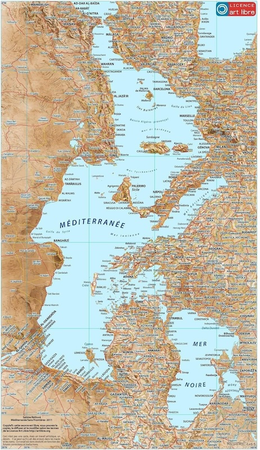
Today on Facebook, someone posted a map of the Mediterranean Sea, annotated in French and unusually rotated with west at the top. It’s a physiographic view overlaid with the names of hundreds of cities of all sizes.

My eye went to the one part of the Med on which I’ve traveled, from Brindisi in the south of Italy, to Kérkera (Corfu) in the west of Greece. And thence the train of memory pulled out of the station.

It was 1980, and I had some time to myself while "between situations" and decided to go to Europe. I bought a Eurailpass, and after a few days of rolling along through Luxembourg, Switzerland, northern Italy and Rome, I arrived by train at Brindisi, a small port on the Adriatic.

The trip from Rome to Brindisi was overnight in a "couchette," a little room in the train with seating for six that could be made into a sleeping space by magically folding the seats and unfolding cots from the two walls, creating six resting places, three on either side, arranged in bunk bed fashion.

With me in the room were
• a former employee of the UN — in Geneva, if I remember correctly — who was traveling with his small daughter to the south of Italy to undertake a new life as a beekeeper; he had been working in an office during the era of the Bader-Meinhoff and Brigade Rosse terror bombings by mail and had decided to give up that work to devote himself to his child; he regaled us for hours on the virtues of honey
• the lovely Gretel M and her traveling companion Tina B, who were touring Europe in the same way as I, looking at the names of towns and cities in a train station and picking a destination on the spur of the moment
•I cannot recall whether or not there was a sixth person, who would have needed to be rather special to compete in memory with the others

We arrived in Brindisi in the morning. The young ladies and I said good-bye to the beekeeper and his daughter, and walked about while we awaited the ferry to Greece. A story for another time.

Time warp! Now it’s a week earlier, and I’m boarding a train from Verona to Venice. It turns out that a first-class Eurailpass ticket does one no good if the first class cars are full, but one can swallow one’s pride and take a second class seat.

Second class on that particular line was open seating in little sets of bench seats facing each other with four places each. I arrived in time to choose my seat on the right facing forward with a large window through which to observe the countryside.

Quickly the car began to fill, and I heard "Sono occupati cuesti…?" — are these seats taken — and I was joined by three young Italian men, with smiles and accommodating gestures all around.

One of the most interesting parts of traveling by train in Europe is "the language negotiation" that occurs at the beginning of a trip, assuming people are in a talkative mood. It quickly becomes apparent which language the most have in common, and that becomes the language of the trip. We four began to introduce ourselves in their Sicilian, my halting Italian, the high school French of one, and my relatively fluent Spanish. The Spanish connection arises, because the dialect of Sicily is very similar to Spanish, to the extent that with a bit of patience they are mutually intelligible. And the train pulled out.

My new friends were Gianni, Roberto and Salvatore, who I learned were construction workers from Sicily, working on a building project in Verona for the summer. We were all on our way to Venice to be tourists. Gianni and Roberto were both worn out from their week’s work, but Salvatore and I began a conversation that lasted most of the trip, whereupon they went their way and I mine. I think he got a kick from the American college professor riding in second class who enjoyed chatting and finding common ground with whomever happened along, probably not an everyday occurrence.

Two days later, as I was walking toward the station to board my train southward, I heard "é, americano!" and turned to see my new amici. We chatted for a moment and said our good-byes. Salvatore handed me a scrap of paper with his address in Sicily. Later in the trip I sent him a postcard, but that was the end of that. The scrap of paper remained — or remains — in the top middle drawer of an old desk at my son’s house; I need to check on that.

Here’s the fun part. Salvatore was clearly engaged with the world, a political person, and our discussions had ranged over many topics of the time, the Vietnam war ("what were you guys thinking?"), terrorism, international affairs, a primer he gave me on Italian politics, etc. Salvatore turned out to be an intellectual, cleverly masquerading as a construction worker.

So today, the map on the Facebook page triggered the memory, so I did a search on his name. It turns out that "salvatore di falco, sicily, sicilia" returns results about several individuals sharing the name, who knew?

One of the results was a page in a Sicilan newspaper, describing the torching of a couple of garbage dumpsters, apparently the result of arson by a political faction aligned with the less savory part of local life in an attempt to intimidate voters. Whose opinion was that? You guessed it: Salvatore di Falco. Whether "my" Salvatore I do not know, but my new flag bears curiosity rampant on a field of green, white and red. It seems entirely in keeping with the young man on the train that he might have become a political leader.

To the original point, each of the players in this little story, if they remember it at all, remembers it differently. If they should ever write down their version and post it on line, some future historian, perhaps an artificial one, may synthesize it into a more complete recitation of the events. Or not. Either way, all hail the WWW!

E se per caso tu fossi il mio Salvatore, per favore scrivimi due righe. É passato troppo tempo.

Creationists Turn Tiny Surtsey into Time-bending Twaddle

From our Anything but Science File:
The young volcanic island of Surtsey formed off the coast of Iceland starting in 1963. Life magazine was all over the story then, but the media lost interest, though Surtsey continued growing. Rapid growth has ceased, and of course life, gravity and erosion have found a way.

Creationists have seized on the emergence of features resembling those used as markers for geologists, claiming that because analogous features have formed quickly on Surtsey, the Earth "could be" much younger than accepted geological models show. Of course, it was only a hop, skip and jump and hosanna" to "IS much younger."

It's even more remarkable than that!

Continues...

Fun Facebook Genealogy Fare
Recently I joined a Facebook group on Welsh Genealogy and found a bit of geographical connection. (Order of posts to Facebook altered to reflect actual sequence of overlapping messages.)

Sue Schultz wrote:
When I was a child, my mother said we were descended from the Prince of Wales. I told the nuns at my school who laughed. 55 years later, doing research + DNA, I did find there was some chance our Griffiths from Ystradgynlais might have descended from a prince of south Wales. At the cathedral in St David's, I did find the sarcophagus of Rhys ap Gryffudd died ca 1187 & said this is good enough for me.

(I spotted the name of Ystradgynlais, a village in Breconshire, Wales. -RC)

Rees Clark wrote:
Sue Schultz — I was in Ystradgynlais a few weeks ago. My Welsh-speaking great-grandmother and earlier generations were born there, and BTW lots of Griffiths and Gruffydds are buried near her in SE Idaho in a little village cemetery with many Welsh names.
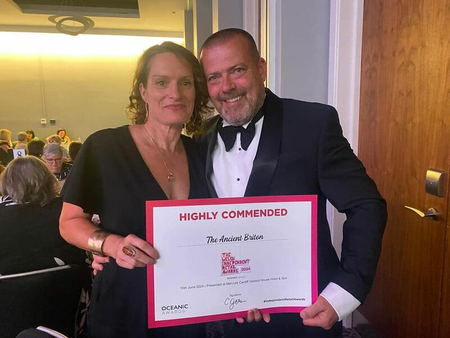
Enjoyed seeing Y's lovely main street, much upgraded since my previous visit 40 years ago, and I recommend the Ancient Britain at edge of town for lunch; try the hake.

Dean Rees, Author, who had started the thread, wrote:
Rees Clark — (an image appeared here) along with a note that Dean's friend owned the local "Ancient Briton" restaurant I mentioned in the earlier reply and that the restaurant had won a culinary award.

Rees Clark wrote:
"Briton" — I stand corrected; the recommendation stands. ????

Rees Clark wrote:
Dean Rees — Absolutely fantastic; congratulate him.
My Welsh cousin drove me around Glamorgan for a couple of days, and we discovered the AB quite by accident. We were astonished and well pleased at the ambience, quality and presentation.
I was lucky in my genealogical quest; my great-grandparents joined the LDS church around 1850, married and took their mining and farming skills to the Appalachians and later to the Rocky Mountains along with thousands of other Welsh folk. As a religious obligation they kept track of their ancestors, and though my grandfather left the church those records came to me from a cousin.
The migration transformed that family; my great-grandmother never learned to read or write, yet her descendants have been farmers and ranchers but also lawyers, soldiers, politicians, professors, world-famous entertainers and successful business executives. Probably all a consequence of attending a revival meeting in Ystradgynlais around 1850. Butterly wings were indeed flapping somewhere!
Vowels and Consonants
Friends of mine on Facebook have been teasing one another about the spelling of their names. Rocky James Curtiss called out his friend and classmate Richard Curtis, about his missing S. So I hastened to point out the causes: "RE spelling, you have to remember the times back in the 40s. WWII caused all kinds of shortages. When I was born in 1943, there was a shortage of Es, so one might think I'm Rees Clark, not Reese Clarke, for that reason; however in reality my name comes from earlier family namesakes. In 1944 there was a shortage of Ss. So there are Curtisses and Curtises; it all depended on rationing rules that were set based on local availability. I'm surprised that the usually adept historian Jeffrey Handley didn't catch that. Now I know some people will attribute the differences to familiy legacy, but as any good Republican will tell you, it was all FDR's fault."
— Revised 2024 — RC